
DeePC
Controle Baseado em Dados
Prof. Dr. Raphael Teixeira
Universidade Federal do Pará
O que é DeePC?
Data-Enabled Predictive Control: controle preditivo formulado direto sobre uma trajetória de dados, sem identificar um modelo de estado da planta.
Motivação
- Identificar um modelo é uma etapa separada, com custo e erro próprios;
- O DeePC substitui o modelo por uma trajetória de dados persistentemente excitante, coletada uma única vez;
- Identificação e controle viram uma única otimização.
Excitação Persistente
Seja \(w_d=(u_d,y_d)\) uma trajetória de comprimento \(T\) de um sistema LTI controlável de ordem \(n\). Sua matriz de Hankel de profundidade \(L\):
\[ H_L(w_d) = \begin{bmatrix} w_d(1) & \cdots & w_d(T-L+1) \\ \vdots & \ddots & \vdots \\ w_d(L) & \cdots & w_d(T) \end{bmatrix} \]
\(u_d\) é persistentemente excitante de ordem \(L\) se \(H_L(u_d)\) tem posto linha completo — na prática, um PRBS longo o suficiente basta.
Lema Fundamental de Willems
Se \(u_d\) é persistentemente excitante de ordem \(L+n\), toda trajetória \((u,y)\) de comprimento \(L\) é combinação linear das colunas de \(H_L(u_d), H_L(y_d)\): existe \(g\) tal que
\[ \begin{bmatrix} H_L(u_d) \\ H_L(y_d) \end{bmatrix} g = \begin{bmatrix} u \\ y \end{bmatrix} \]
A matriz de Hankel dos dados é um modelo implícito do sistema — a ponte entre a abordagem comportamental e o controle baseado em dados (Markovsky; Huang; Dörfler, 2023).
Formulação do DeePC
Particiona-se \(H_L(u_d), H_L(y_d)\) em blocos “passado” (\(T_{\text{ini}}\) linhas) e “futuro” (\(N\) linhas), \(L=T_{\text{ini}}+N\):
\[ \min_{g,\, u,\, y} \; \sum_{k=1}^{N} \|y_k - r_k\|_Q^2 + \|u_k\|_R^2 \quad \text{s.a.} \quad \begin{bmatrix} U_p \\ Y_p \\ U_f \\ Y_f \end{bmatrix} g = \begin{bmatrix} u_{\text{ini}} \\ y_{\text{ini}} \\ u \\ y \end{bmatrix} \]
\(U_p,Y_p\) fixam \(g\) ao passado recente (estimam o estado); \(U_f,Y_f\) predizem: \(y=Y_fg\), \(u=U_fg\) (Coulson; Lygeros; Dörfler, 2019a).
Horizonte Deslizante
- Atualiza-se \((u_{\text{ini}}, y_{\text{ini}})\) com as últimas medições;
- Resolve-se a otimização, obtendo \(u^\ast_{1:N}\);
- Aplica-se só \(u^\ast_1\) e repete-se.
Nota
\(T_{\text{ini}}\) precisa ser \(\geq\) à ordem do sistema, para fixar o estado inicial implícito.
Python — Dados
Sistema de 1ª ordem \(y_{k+1}=ay_k+bu_k\), usado só para gerar dados (o DeePC nunca vê \(a,b\)):
Python — Matrizes de Hankel
Up/Yp: passado (\(T_{\text{ini}}\) amostras); Uf/Yf: futuro (\(N\) amostras).
Python — Resolver e Predizer
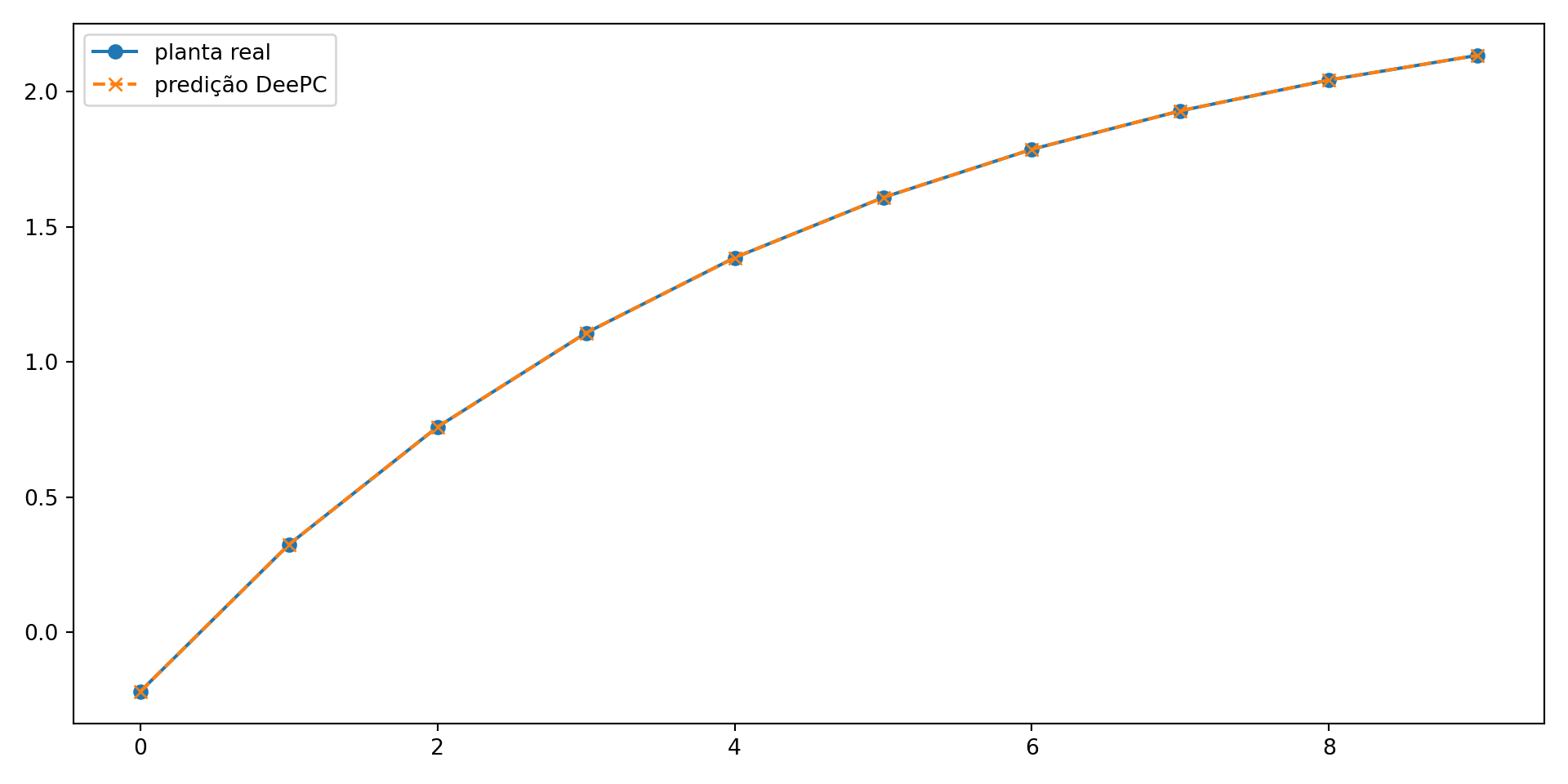
Nova condição inicial e um degrau futuro — a partir daqui, a, b não são usados:
Python — Resultado
Interpretação
As curvas coincidem: o Lema Fundamental garante que Yf @ g reproduz a planta exatamente, sem nunca estimar \(a\) e \(b\).
Regularização
Com ruído, \(g\) fica mal-condicionado. Solução: penalidades (Coulson; Lygeros; Dörfler, 2019b)
\[ \min_{g,\, u,\, y} \; \sum_{k=1}^{N} \|y_k - r_k\|_Q^2 + \|u_k\|_R^2 \;+\; \lambda_g \|g\|_2^2 \;+\; \lambda_y \|\sigma_y\|_1 \]
- \(\lambda_g\|g\|_2^2\): regulariza \(g\) (Tikhonov);
- \(\sigma_y\): absorve ruído em \((u_{\text{ini}},y_{\text{ini}})\);
- Validado em conversores de potência (Huang et al., 2021a).
Garantias Teóricas
- Estabilidade e robustez com dados ruidosos (Berberich et al., 2021);
- Otimalidade equivalente ao MPC baseado em modelo, sem ruído (Dörfler; Coulson; Markovsky, 2023);
- Relação formal com controle preditivo por subespaços (Fiedler; Lucia, 2021).
DeePC vs. MPC Clássico
| MPC clássico | DeePC | |
|---|---|---|
| Modelo | Sim, \((A,B,C,D)\) | Não |
| Identificação | Separada | Embutida na otimização |
| Ruído | Modelo já filtra | Exige regularização |
| Garantias | Maduras | Em consolidação (Li et al., 2025) |
Aplicações
- Conversores conectados à rede (Huang et al., 2019);
- Amortecimento descentralizado de oscilações (Huang et al., 2021b);
- Extensões não lineares via redes neurais (Lazar, 2024).
Referências
BERBERICH, Julian et al. Data-Driven Model Predictive Control with Stability and Robustness Guarantees. IEEE Transactions on Automatic Control, v. 66, n. 4, p. 1702–1717, 2021.
COULSON, Jeremy; LYGEROS, John; DÖRFLER, Florian. Data-Enabled Predictive Control: In the Shallows of the DeePC. In: IEEE, a2019.
COULSON, Jeremy; LYGEROS, John; DÖRFLER, Florian. Regularized and Distributionally Robust Data-Enabled Predictive Control. In: IEEE, b2019.
DÖRFLER, Florian; COULSON, Jeremy; MARKOVSKY, Ivan. Bridging Direct and Indirect Data-Driven Control Formulations via Regularizations and Relaxations. IEEE Transactions on Automatic Control, v. 68, n. 2, p. 883–897, 2023.
FIEDLER, Felix; LUCIA, Sergio. On the Relationship between Data-Enabled Predictive Control and Subspace Predictive Control. In: IEEE, 2021.
HUANG, Linbin et al. Data-Enabled Predictive Control for Grid-Connected Power Converters. In: IEEE, 2019. Disponível em: <https://arxiv.org/abs/1903.07339>
HUANG, Linbin et al. Quadratic Regularization of Data-Enabled Predictive Control: Theory and Application to Power Converter Experiments. IFAC-PapersOnLine, v. 54, n. 7, p. 192–197, a2021.
HUANG, Linbin et al. Decentralized Data-Enabled Predictive Control for Power System Oscillation Damping. IEEE Transactions on Control Systems Technology, v. 30, n. 3, p. 1065–1077, b2021.
LAZAR, Mircea. Neural Data-Enabled Predictive Control. arXiv preprint arXiv:2406.08003, 2024.
LI, Xiaojie et al. Efficient Data-Driven Predictive Control of Nonlinear Systems: A Review and Perspectives. Digital Chemical Engineering, v. 14, p. 100219, 2025.
MARKOVSKY, Ivan; HUANG, Linbin; DÖRFLER, Florian. Data-Driven Control Based on the Behavioral Approach: From Theory to Applications in Power Systems. IEEE Control Systems Magazine, v. 43, n. 5, p. 28–68, 2023.
WILLEMS, Jan C. et al. A Note on Persistency of Excitation. Systems & Control Letters, v. 54, n. 4, p. 325–329, 2005.
Encerramento

Prof. Dr. Raphael Teixeira
Universidade Federal do Pará