Aprendizagem por Reforço
Controle Baseado em Dados
Prof. Dr. Raphael Teixeira
Universidade Federal do Pará
O que é Aprendizagem por Reforço?
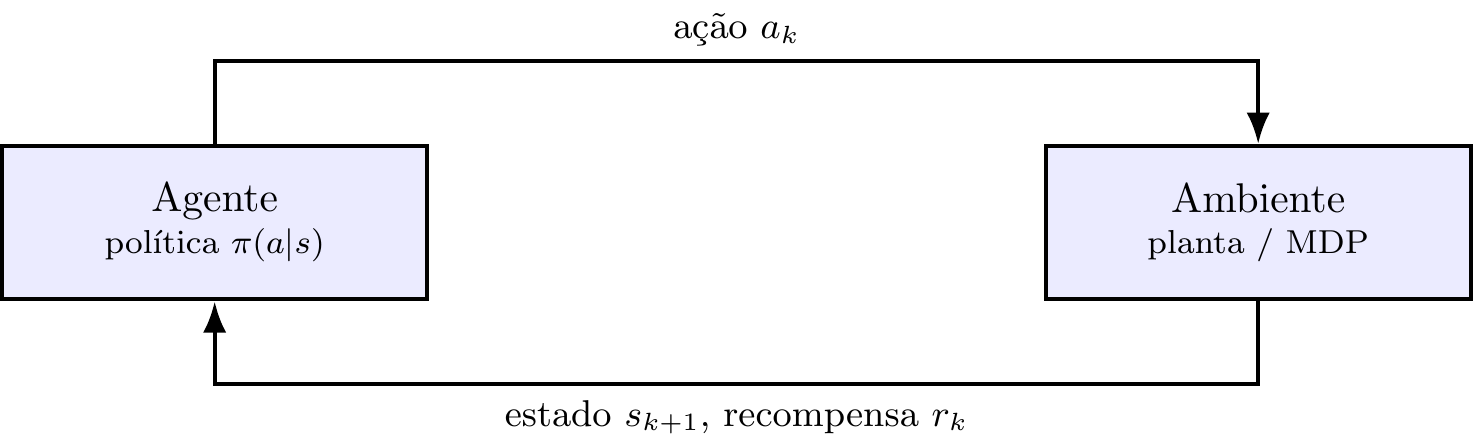
Um agente aprende a agir sobre um ambiente por tentativa e erro, maximizando recompensa acumulada — sem que ninguém lhe diga a ação certa.
Processos de Decisão de Markov
Um MDP é a tupla \((\mathcal{S}, \mathcal{A}, P, r, \gamma)\): estados, ações, \(P(s'|s,a)\) (transição), \(r(s,a)\) (recompensa), \(\gamma\) (desconto).
Uma política \(\pi(a|s)\) mapeia estados em ações. Objetivo: maximizar \(\mathbb{E}\left[\sum_{k} \gamma^k r(s_k,a_k)\right]\).
Nota
Em controle: \(\mathcal{S}\) é o estado da planta, \(\mathcal{A}\) a entrada, \(-r\) o custo por estágio (Kaelbling; Littman; Moore, 1996).
Valor e Equação de Bellman
\(Q^\pi(s,a)\): retorno esperado seguindo \(\pi\) a partir de \((s,a)\).
A política ótima satisfaz (Bellman, 1957): \[ Q^\ast(s,a) = \mathbb{E}_{s'}\left[r(s,a) + \gamma \max_{a'} Q^\ast(s',a')\right] \] e \(\pi^\ast(s) = \arg\max_a Q^\ast(s,a)\).
Q-Learning
Q-learning (Watkins; Dayan, 1992) aprende \(Q^\ast\) só observando transições \((s,a,r,s')\):
\[ Q(s,a) \leftarrow Q(s,a) + \alpha \Big[ r + \gamma \max_{a'} Q(s',a') - Q(s,a) \Big] \]
- Exploração \(\varepsilon\)-greedy: ação aleatória com prob. \(\varepsilon\);
- Converge para \(Q^\ast\) sob condições brandas (Sutton; Barto, 2018).
RL Profundo
Para estados contínuos, tabelas viram redes neurais:
- DQN: nível humano em Atari, a partir de pixels (Mnih et al., 2015);
- DDPG: ações contínuas, ator-crítico (Lillicrap et al., 2016);
- PPO: gradiente de política, hoje padrão em controle contínuo (Schulman et al., 2017).
RL e Controle Ótimo: a Ponte
No fundo, o mesmo problema (Bertsekas, 2019):
| Controle ótimo | RL |
|---|---|
| Custo \(\ell(x,u)\) | Recompensa \(-r(s,a)\) |
| Riccati / HJB | Equação de Bellman |
| Programação dinâmica | Iteração de valor/política |
| LQR | Caso exatamente solúvel |
Para controle contínuo, muito do que RL “descobre” já tem solução fechada na teoria clássica (Recht, 2019) — o exemplo a seguir mostra isso.
Referências
BELLMAN, Richard. Dynamic Programming. [S.l.]: Princeton University Press, 1957.
BERTSEKAS, Dimitri P. Reinforcement Learning and Optimal Control. [S.l.]: Athena Scientific, 2019.
KAELBLING, Leslie Pack; LITTMAN, Michael L.; MOORE, Andrew W. Reinforcement Learning: A Survey. Journal of Artificial Intelligence Research, v. 4, p. 237–285, 1996.
LILLICRAP, Timothy P. et al. Continuous Control with Deep Reinforcement Learning. International Conference on Learning Representations (ICLR), 2016.
MNIH, Volodymyr et al. Human-Level Control through Deep Reinforcement Learning. Nature, v. 518, p. 529–533, 2015.
RECHT, Benjamin. A Tour of Reinforcement Learning: The View from Continuous Control. Annual Review of Control, Robotics, and Autonomous Systems, v. 2, p. 253–279, 2019.
SCHULMAN, John et al. Proximal Policy Optimization Algorithms. arXiv preprint arXiv:1707.06347, 2017.
SUTTON, Richard S.; BARTO, Andrew G. Reinforcement Learning: An Introduction. 2. ed. [S.l.]: MIT Press, 2018.
WATKINS, Christopher J. C. H.; DAYAN, Peter. Q-Learning. Machine Learning, v. 8, p. 279–292, 1992.
Encerramento

Prof. Dr. Raphael Teixeira
Universidade Federal do Pará